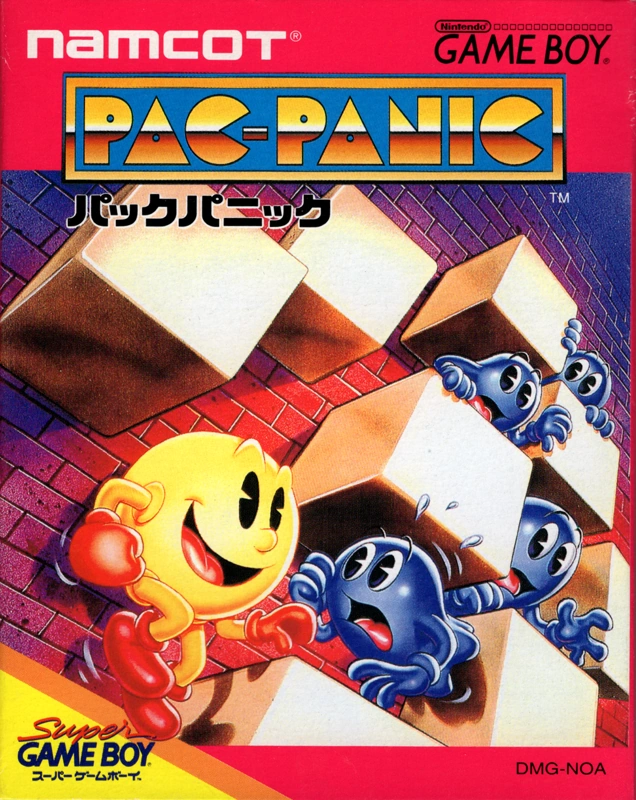
Pac-Attack (パックアタック Pakkuatakku), also known as Pac-Panic (パックパニック Pakkupanikku) in some international releases, is a puzzle game developed by Namco and published by Namco Hometek in the U.S., originally released in 1993 for the Super Nintendo Entertainment System and Sega Genesis/Mega Drive. Ports of Pac-Attack to the Game Gear and Game Boy would follow in 1994.
Pac-Attack is a localization of Cosmo Gang the Puzzle, a Namco-developed arcade game which was also ported to the Super Famicom a year prior. While gameplay remains identical from Cosmo Gang the Puzzle, all the visuals and sounds are replaced with elements from the Pac-Man series.
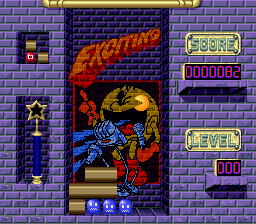
Pac-Attack is a falling block puzzle game similar to Tetris, where the player must use blocks, ghosts and Pac-Man to score points before they fill the board.
Upon starting the game, pieces of three combined tiles in "L"-shaped formations will fall down into the playfield. The player can move the piece formation by pressing Left and Right on the directional pad, and can rotate the pieces clockwise by pressing the button. The player can also speed up the piece's descent by pressing the Down direction. When the piece touches the ground for a period of time, it will lock into place and fall to the ground (including individual segments hovering in the air). The next piece formation to fall in is indicated by a preview window in the top-left corner of the screen.
Each block piece consists of three different types of tiles. Gold Blocks are the most common type of tiles; the Gold Blocks will disappear when a full line of them is filled. Ghosts (Blinky) will occupy a vast majority of pieces, and prevent lines from disappearing. One Pac-Man tile will periodically appear after a select amount of pieces are dropped, causing all ghosts to become scared and blue. When the Pac-Man piece locks in place, Pac-Man will begin moving in the direction he is facing and will eat Ghosts he is touching. He will fall downwards upon reaching a block gap and will rebound to the other side of which he is moving when he touches a wall, before eventually disappearing once he reaches a dead end. Depending on the difficulty level, Pac-Man can appear as a standalone block or attached to further Gold Block/Ghost pieces. A Pac-Man piece will appear once every three pieces, though this length will increase up to five pieces as the game progresses.
The player earns points for every time a piece is dropped faster, but will gain larger amounts of bonus points if they clear multiple blocks and ghosts in a single move. By placing the blocks and ghosts in different formations, the player can use Pac-Man to clear ghosts underneath blocks and cause a chain reaction. The player levels up as they accumulate points. In the higher levels, the descent speed of the pieces will begin increasing drastically, though they will sometimes loop back to the original starting speed.
On the left side of the screen, there is a "Fairy Meter" (represented by a wand) that charges as ghosts are eaten. When it is filled up, a piece featuring a single Fairy will appear in place of the Pac-Man pieces. When the fairy lands and locks in place, it will cast a magical wave that clears all ghosts seven rows beneath it; often resulting in cleared lines of blocks as they fall. The Fairy Meter requires more ghosts to fill up each time a Fairy appears. The player can also "cancel" a Fairy, either by dropping it on an unobscured floor tile or pressing a button on the controller; when the Fairy is cancelled, it will fly back to the top of the screen, granting a 100,000 point bonus and filling the next Fairy Meter up by 50 percent.
As the game progresses, the pieces' descent speed will continue to drastically increase. If the top of the third or fourth rows are filled with either a ghost or block by the next turn, the board will top out and the game ends.
Game modes
Pac-Attack features three game modes (two in some releases):
Normal Mode
Normal Mode (also dubbed as "1P Normal Game") is the standard mode of gameplay. The player's goal is to score as many points as possible before the top spaces of the third and fourth rows of the field are filled up. The player can choose between four starting game speed difficulties:
Easy begins at level 0; the player starts with a score of 0 points.
Normal begins at level 10; the player starts with a score of 100,000 points.
Hard begins at level 40; the player starts with a score of 500,000 points.
Hyper begins at level 100; the player starts with a score of 2,000,000 points.
Puzzle Mode
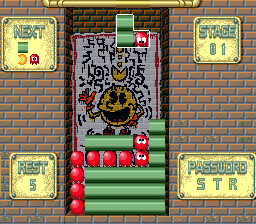
Gameplay of the fifth level in Puzzle Mode, from the SNES version.
In Puzzle Mode (also dubbed as "1P Puzzle Game"), the player is tasked with completing a set of 100 puzzles. Unlike the other game modes, the main goal of this game mode is to clear the field of all ghosts using Pac-Man pieces.
Each board starts with a predetermined layout of blocks and ghosts. The player has a limited amount of Pac-Man pieces to use, as indicated by the "Rest" number on-screen. Unlike the regular game modes, the player is able to change the direction Pac-Man faces by using the respective controller buttons ("X" button on SNES, "B" button on Genesis), allowing the player to have more control over Pac-Man's movement. In the later rounds, the game will introduce two exclusive variants of blocks: gray metal blocks are shielded variants of blocks that damage upon a line clear, and fully disappear after the next line clear; purple screw blocks are blocks that float in mid-air, but can still be cleared.
The round is cleared when all ghosts in the playfield are eaten. If the player completes the round with the minimum amount of Pac-Men possible, they will receive a "Good" stamp for that round. The player will fail the round if they run out of Pac-Man pieces or they top out the board. When the player clears the 100th round, the game is cleared and the player will receive a congratulatory message.
Within every round, a password is displayed on the bottom right of the screen, which can be used to input on the password screen and continue the game from said round.
Versus Mode
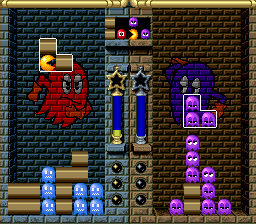
Gameplay of the Versus Mode in the SNES version.
Versus Mode (also dubbed as "2P Versus Game") is a two-player game mode where two players compete with each other in order to be the surviving player. The first player's ghosts are represented by Blinky, while the second player's ghosts are represented by Sue. The gameplay largely follows similar rules to the Normal (1P Normal Game) mode. The players are able to independently choose their starting speed between Low, Middle and High.
In this game mode, using Pac-Man to eat more than 5 ghosts at once will allow the player to send ghost tiles to the opponent's playfield; eating more ghosts in a single move will increase the amount of ghost tiles sent to the other player. The players can also use the fairies to clear ghosts, and can often use them to send large amounts of ghosts to each other's playfields.
A round ends when either one of the player's playfields are topped out. The surviving player will earn a victory light indicated in the middle of the screen. The player that accumulates three round victories will win the Versus game.
Namco Anthology 2 remake
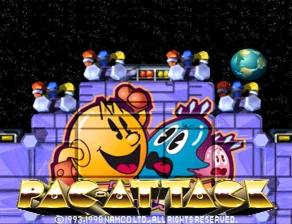
Title screen for the Namco Anthology 2 remake of Pac-Attack.
An enhanced remake of Pac-Attack is included in Namco Anthology 2, a Namco-themed collection released exclusively in Japan for the original PlayStation. The remake is included alongside a more traditional port based on the original Sega Genesis/Mega Drive version.
The enhanced remake features an overhaul to the game's visuals, changing the original game's rusty street theme to a space-themed feel, making it similar to Cosmo Gang the Puzzle. The actual gameplay remains largely unchanged save for several differences in its presentation.
Differences from the original Pac-Attack
All visuals are redone from the ground up, now featuring pre-rendered 3D graphics with a space theme.
The game's soundtrack is completely redone, now featuring an emphasis on techno instruments.
Several features for each of the game modes and difficulties are changed:
The "Normal" mode is now known as "Arcade Game".
The difficulties for each game mode are changed to the following: Easy to Beginner, Normal to Novice, Hard to Standard, and Hyper to Veteran.
There is a secret additional difficulty known as "God-hand", which can be accessed by inputting a secret command seen in the endings for the regular difficulties in "Arcade Game" mode and the ending to Road to God-hand. God-hand starts the player at the 900th speed level, making it extremely difficult to control the pieces. The game will be completed upon finishing the 999th speed level, with the true ending and staff credits being shown afterwards. In the background of this mode, an illustration of Jr. Pac-Man can be seen where he gives a thumbs up to the player.
The amount of pieces remaining until the Pac-Man piece appears is now indicated by a meter on the left side of the screen.
When Pac-Man eats ghosts, he will say the amount of points that were accumulated by his recent move.
The "Puzzle" mode is now known as "Road to God-Hand". The mode is completely redesigned and features a new guide.
The block pieces can now be rotated counter-clockwise instead of solely clockwise. This also applies to the "standard" Genesis-based Pac-Attack port included in Namco Anthology 2.
Fairies now clear all blocks seven rows below it as well as ghosts.
In the Head-to-Head (Versus) mode, opponent attacks by eating 5 ghosts or more will instead cause the playfield to rise by rows depending on the amount of ghosts eaten. The opponent blocks are erased by clearing two lines of Blocks.
Development
Pac-Attack began loose development in 1992, as the arcade version of Cosmo Gang: The Puzzle was being finalized. A then-new hire at Namco's home console department, Nikkō Yamashita, was fond of Cosmo Gang: The Puzzle; going so far as to make a home console port of the game during his training, without Namco instructing him to do so. Yamashita would later work on the Cosmo Gang project officially, presumably the Super Famicom version.[1]
After Cosmo Gang: The Puzzle was completed, it was decided to alter the game into a Pac-Man title for its North American release. Both Yamashita and "Katayama-san", the lead programmer of Cosmo Gang: The Puzzle, would be tasked with creating the Pac-Man-themed version, which would ultimately become Pac-Attack.[1] Due to the game being designed for overseas markets, most of the original home ports of Pac-Attack were not published in Japan; though the Game Boy version would be released in Japan in late 1994 (under the "Pac-Panic" name).
Home Ports
Pac-Attack has seen a wide variety of ports since its original release. While most recent releases use ports based on either the Sega Genesis/Mega Drive or SNES versions, some earlier compilations use the Namco Anthology 2 "Classic" version, with a few instances (namely Pac-Man World 2) using the Namco Anthology 2 "remake".
The original Cosmo Gang the Puzzle had ports for Super Famicom and Wii (Virtual Console), both of which were Japan-exclusive; a mobile version was also released. In 2024, the game was released in the Arcade Archives series (for both Nintendo Switch and PlayStation 4), and was later included on the Super Nintendo Entertainment System - Nintendo Switch Online app.
Presumably by accident, the menu preview picture for the game is a screenshot of the Phillips CD-i version.
Game Boy
When played on a Super Game Boy, the game will have extra colors; unlike most Super Game Boy-enhanced titles, there is no special screen border.
Game Boy Color
Included in Pac-Man: Special Color Edition, which also featured the original Pac-Man.
Game Boy Advance
Included in Pac-Man Collection; based on the Namco Anthology 2 "Classic" version.
Versus Mode is removed.
On the title screen of Pac-Attack, the Appendix section of Puzzle Mode will be triggered when selecting that mode and then pressing the A button while simultaneously holding the right arrow button on the control pad. This section features a more difficult version of Puzzle Mode, in which Pac-Man appears fewer times per stage, and each of the clusters in every stage is fixed rather than random.
Nintendo GameCube
Two versions were released, both of which are unlockable "bonuses" in other titles. The Namco Anthology 2 "classic" port was included in Namco Museum, while the Anthology 2 "remake" was featured as a bonus game in Pac-Man World 2.
Game Gear
iOS (iPhone, iPad, etc.)
A standalone app released in 2010; it was removed from the App Store on March 30th, 2015.
The iOS port is considerably different than other releases, seemingly to make the game more accessible. Most notably, when dropping a Pac-Man piece, only the ghosts which Pac-Man would eat in the player's move turn blue; giving clearer visual indication of how the move will play.
The graphics have been simplified, including replacing the background wallpaper with a grid. All music tracks have been completely redone.
Features an additional "Scramble Mode". The exact details of this mode are unknown, though it reportedly featured Facebook connectivity, and allowed the player to "compete" for high scores with other players.[2]
Nintendo Switch
Two versions were released. The game was featured in Pac-Man Museum +, and was featured as an unlockable game in Pac-Man World 2 Re-Pac. Both releases are near-identical emulated ports of the SNES version.
Nintendo Switch 2
Included as an unlockable bonus game in Pac-Man World 2 Re-Pac; uses the SNES version.
Phillips CD-i
Only released in Europe (under the "Pac-Panic" name), and seemingly developed by Philips themselves.
The game's graphics and music have been redone, though are still loosely modeled after the SNES/Genesis versions. Most artwork of Pac-Man is given eye whites and sneakers, similar to the Pac-Man 2 in-game design.
The "Level" counter reportedly maxes out at level 114 (whereas other ports can reach up to level 999); it is unclear if this is intentional or a glitch.
While the Versus Mode is intact, it is unplayable on many CD-i consoles, as a majority of system models only have one controller port.
PlayStation
Included in the Japan-exclusive Namco Anthology 2.
Namco Anthology 2 includes the enhanced remake of the game, while also including a port of the Sega Genesis version of the game featuring the following differences:
The colors now fade in smoothly.
Like the enhanced remake, the player can now rotate the pieces counter-clockwise.
Some sound effects use low quality sample recordings.
PlayStation 2
Two versions were released, both of which are unlockable "bonuses" in other titles. The Namco Anthology 2 "classic" port was included in Namco Museum, while the Anthology 2 "remake" was featured as a bonus game in Pac-Man World 2.
PlayStation 3
Two versions were released. The game was included in Pac-Man Museum, and was featured in the PS one Classics release of Namco Anthology 2.
PlayStation 4
Two versions were released. The game was featured in Pac-Man Museum +, and was featured as an unlockable game in Pac-Man World 2 Re-Pac. Both releases are near-identical emulated ports of the SNES version.
PlayStation 5
Included as an unlockable bonus game in Pac-Man World 2 Re-Pac; uses the SNES version.
PlayStation Portable
Featured in the PS one Classics release of Namco Anthology 2.
PlayStation Vita
Featured in the PS one Classics release of Namco Anthology 2.
Pocket Player (My Arcade)
Included in the Pac-Man Pocket Player; uses the Sega Genesis version (under the "Pac-Panic" name).
Sega Mega Drive/Genesis
Shortly postdates the SNES version; most modern re-releases use one of the two versions.
Compared to the SNES release, the Genesis version's soundtrack features several differences in the game's music. For instance, the high-score screen theme ("The High Life") runs at a slower tempo with different percussion.
Sega Mega Drive (TecToy)
Several 2000s Mega Drive consoles manufactured by TecToy - the official distributor of Sega consoles in Brazil - feature Pac-Attack as a built-in game. The earliest of these consoles feature an actual cartridge slot, whereas later ones do not (effectively making them "Plug & Play" systems).
Super Nintendo Entertainment System
The SNES version was the first to be released, which was shortly proceeded by a nearly identical Sega Genesis port; most modern re-releases use one of the two versions.
Tabletop Arcade Machine
Included on the Namco Museum Mini Player by My Arcade (under the "Pac-Panic" name). Uses the Sega Genesis version (save for altered copyrights).
The game runs at PAL speed, making it play slower. While this is technically accurate performance (given it is running the European ROM), the Pocket Player runs the same version at NTSC speed.
Wii
A standalone release of the SNES version was released for the Virtual Console.
Wii U
Two versions were released, both for the Virtual Console: a standalone release of the SNES version, as well as being featured in Pac-Man Collection for the Game Boy Advance.
Windows PC
Pac-Attack has been released for Windows platforms in several forms: being included in titles such as Pac-Man World 2, Pac-Man Museum, and Pac-Man Museum +.
Xbox
Two versions were released, both of which are unlockable "bonuses" in other titles. The Namco Anthology 2 "classic" port was included in Namco Museum, while the Anthology 2 "remake" was featured as a bonus game in Pac-Man World 2.
Xbox 360
Included in Pac-Man Museum; based on the Namco Anthology 2 "classic" version.
Xbox One
Two versions were released. The game was featured in Pac-Man Museum +, and was featured as an unlockable game in Pac-Man World 2 Re-Pac.
Xbox Series X/S
Included as an unlockable bonus game in Pac-Man World 2 Re-Pac; uses the SNES version.
Play Online
These versions of Pac-Attack are either listed in the public domain or are considered abandonware. Clicking the game title will lead you to a playable online version of it from archive.org (mobile compatibility may vary).
If the player gets a game over in the Puzzle Mode in the SNES version, the player can use the L and R buttons to skip between rounds.
If the player begins a Normal game and selects the Hyper difficulty while holding Right on the D-Pad + the A button (+ L + R on SNES) on the controller, the game will begin at the 300th speed level.
If the player inputs the same commands but holds down Right and Down on the D-Pad, the game will begin at the 900th speed level.
The secret difficulty command acts similar to what would later be known as the "God-hand" difficulty in the Namco Anthology 2 remake of Pac-Attack.
Pac-Attack's graffiti-like aesthetic was inspired by graffiti sprayed under the railroad tracks in Sakuragichō Station (located in Yokohama, Japan), which Katayama had taken a liking to.[1]
In a 2022 interview with Nikkō Yamashita, he suggests that the Fairies assist Pac-Man in Pac-Attack to return the favor of Pac-Man saving them in Pac-Land.[1]
The box art for Pac-Panic in Japan changes Pac-Man's expression.
In the box art for the Japanese release of "Pac-Panic", Pac-Man's angry eyebrow expression is edited to tone down his expression.
The edited box art is also featured in Pac-Man Museum + as the game's border art.
Early design documents for the game refer to it as "Pac-Tris", presumably to imply a connection to the Tetris series.[3] A trademark was also registered by Namco under this name.[4]
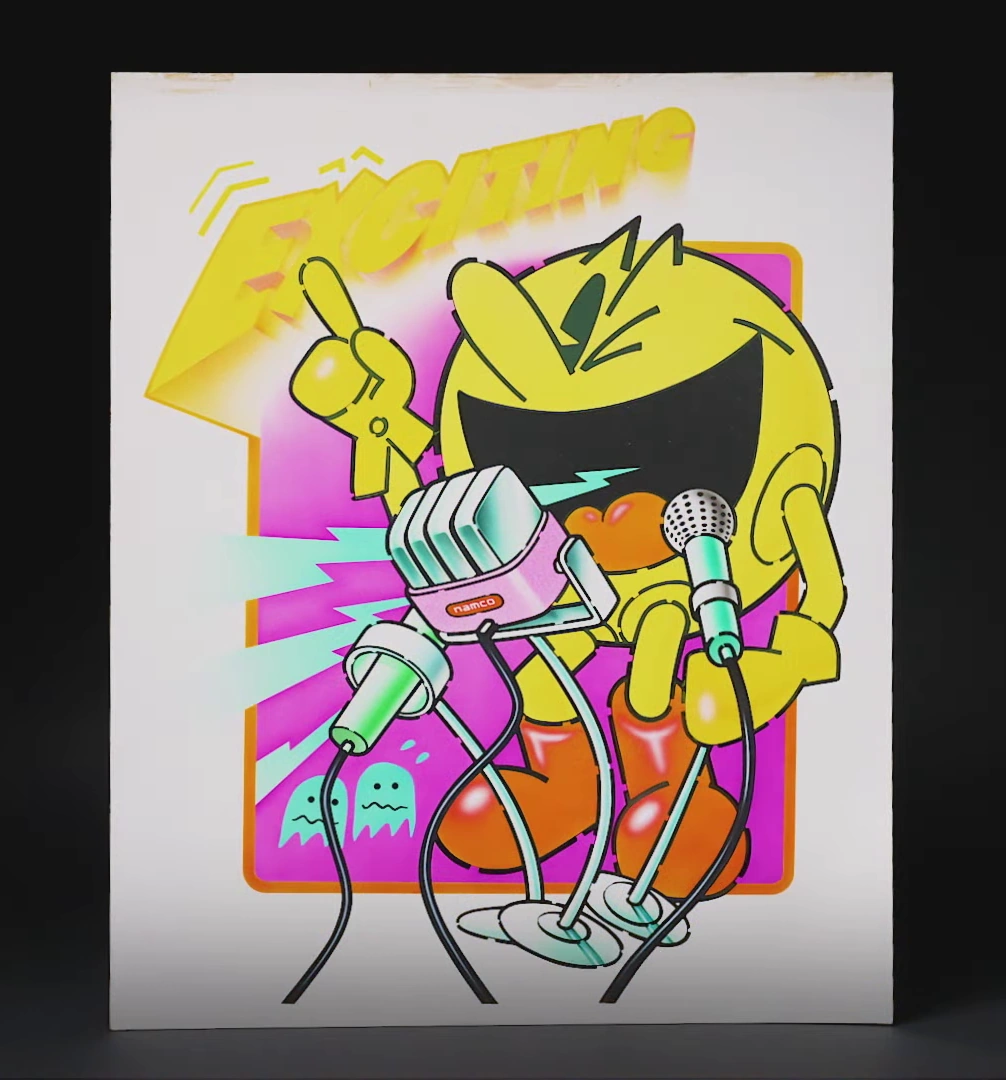
Master painting of the artwork used as basis for the background in Pac-Attack.
The main background artwork in "Normal Mode" (showing Pac-Man shouting into a microphone) is based on an early piece of Pac-Man artwork illustrated by Tadashi Yamashita. Prior to Pac-Attack's release, the original artwork was used mainly for merchandising and advertising; as well as the Taiwanese version of the Puckman arcade machine, and several Pac-Man home console ports.
While not appearing in the main game itself, Ms. Pac-Man and Baby Pac-Man appear in the background of the Records screen.
Possibly due to its very minuscule nature, this cameo was seemingly never subject to any legal issues regarding Ms. Pac-Man, and was retained in modern ports of the game. However, the Pac-Man Museum + release replaces these graphics with "Pac-Mom" and "Pac-Sis".
Some later rounds of the Namco Anthology 2 "enhanced" version feature what appears to be Jr. Pac-Man in the background, specifically the "Pac-Jr." design seen in Pac-Man 2: The New Adventures.
While no official reasoning has been given, the purpose of Pac-Attack being renamed "Pac-Panic" in some releases was likely to comply with regulations in select European countries. Several further IPs around this time received similar name alterations in Europe, often to remove "violent" words or phrases (e.g. Bomberman being renamed to Dynablaster).
For unknown reasons, most 2010s "plug & play" releases of Pac-Attack (such as those by My Arcade, AtGames, etc.) used the "Pac-Panic" name, despite that being the less commonly known title.
Blaze, the company behind Namco Museum Collection 2, seemed particularly confused about this, with the name frequently being swapped and re-swapped on promotional pictures. It ended up launching under the "Attack" name.
The Phillips CD-i version's credits sequence features quoted nicknames for the lead developers (e.g. Tom "Illogical" Drummond). One of these nicknames is Johnny "[Censored]" Wood, presumably implying a vulgar joke.
Further questionable credits were featured in Arcade Classics for CD-i, which shared much of the same development staff.
The Phillips CD-i version was originally planned to have an animated intro sequence; the storyboard for the opening was completed, but it never entered production.[5]
The storyboard shows Chomp-Chomp retrieving a newspaper headlined that the "Ghosts' Back!" [sic], leading to Pac-Man leaving home to go after the ghosts; Baby Pac-Man unknowingly tags along. Pac-Man's car (a "Pacmobile" featuring an angry grinning face) is unable to start, so he fills it with Power Pellets as fuel; he chases down the ghosts' car, after which, the ghosts get eaten by the Pacmobile. A crowd cheers as Pac-Man zooms by; to which Pac-Man inexplicably steals a little girl's ice cream, leaving her crying (accompanied with the narration "Pac is back, and he's hungry").[5]
Not seen in the published storyboards is a reported scene where Pac-Man (and Baby Pac-Man) arrive at a "MegaPie Factory"; this was specifically a factory of British meat pies, rather than regular pies more commonly used in slapstick. Pac-Man would navigate the pie factory's crates to trap and hunt down the ghosts. Johnny Wood has stated that "megapies" were an inside joke between the Phillips ADS staff, with the staff attempting to find "the largest, lardiest pie on sale".[5]
A mobile sequel to Cosmo Gang the Puzzle was released in Japan titled Taisen Cosmo Gang in the mid-2000s (?). This game retained the gameplay rules of the original, and featured online play against other players.[6]
The game's naming scheme is shared by Taisen Pac-Man, a mobile Pac-Man game with (non-online-focused) multiplayer.